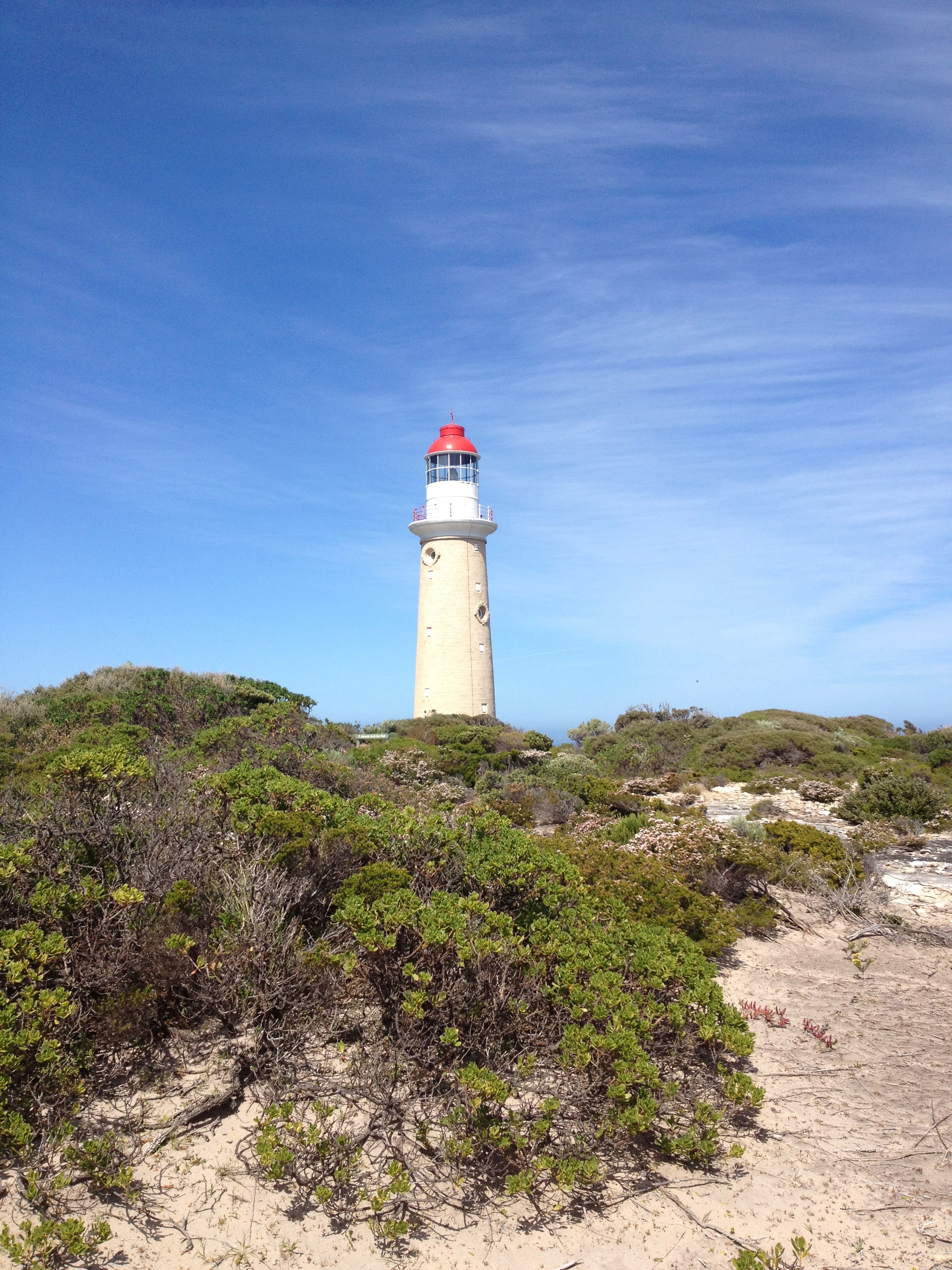
Cape du Couedic Lighthouse
The allure of lighthouses is part isolated setting, part design, part engineering feat. In the nineteenth century, Robert Louis Stevenson wrote that engineering ‘was not a science…It was a living art, and it visibly grew under the eyes and between the hands of its practitioners’. He should know. Between 1790 and 1940, eight members of the Stevenson family – his great grandfather, grandfather, two uncles and his father – planned, designed and constructed the ninety-seven manned lighthouses along the Scottish coast.
The elegant Cape du Couedic lighthouse on the rugged south-west corner of Kangaroo Island typifies Stevenson’s living art claim. Beautifully proportioned, it’s built from 2,000 blocks of local sandstone, including several huge carved blocks which must have stretched the engineering imagination of the day. Running my hand over the curved stone sills I can’t help but wonder, who carved this stone? what tools did they have? how did they position the stone?
Cape du Couedic was named by French explorer Nicholas Baudin, after a French naval officer, Charles Louis Couëdic. Baudin gave French names to bays and capes on the south coast of Kangaroo Island, while Matthew Flinders, whom he met in the aptly named Encounter Bay in April 1802, was giving English names to the north coast.
Cape du Couedic rises 25-metres above the windswept, desolate Cape and began operating in 1909 to help prevent wrecks like the Loch Sloy. In 1889, after 124 days at sea, with thirty-five people and cargo valued at £30,000 onboard, the Glasgow-built iron barque hit a reef off the Cape. Only four survived.
Fourteen ships were wrecked – including Stella, the 40-foot fishing cutter which began the crayfish industry in South Australia – and 79 lives were lost around Cape du Couedic.
Like Cape Borda, Cape du Couedic was inaccessible by land and a landing site for supplies and building materials was established at Weirs Cove, north of the lighthouse site. Goods arriving by steamer – every three months or so – were carried up a path cut into the face of the cliff until a flying fox was installed.
Further reading and some useful websites…
Bathurst, Bella. The Lighthouse Stevensons. New York: Perennial, Harper Collins, 1999
Chapman, Gifford. Kangaroo Island Shipwrecks. Limited Edition published by the Author: 2007 (first printed Roebuck, 1972)
Ibbotson, John. Lighthouses of Australia. Australia: Australian Lighthouse Traders, 2001
Loney, Jack. An Atlas History of Australian Shipwrecks. Sydney: A.H. & A.W Reed Pty Ltd, 1981
Reid, Gordon. From Dusk to Dawn. Australia: The Macmillan Company of Australia Pty Ltd, 1988
Websites
http://www.australiaforeveryone.com.au/places_kangarooisld.htm
Lighthouses of Australia websites
http://www.lighthouse.net.au/Lights/SA/Cape%20du%20Couedic/Cape%20du%20Couedic.htm
http://www.lighthouse.net.au/lights/Bulletin/0304/Bulletin%20Apr%2003.htm
 australian lighthouses