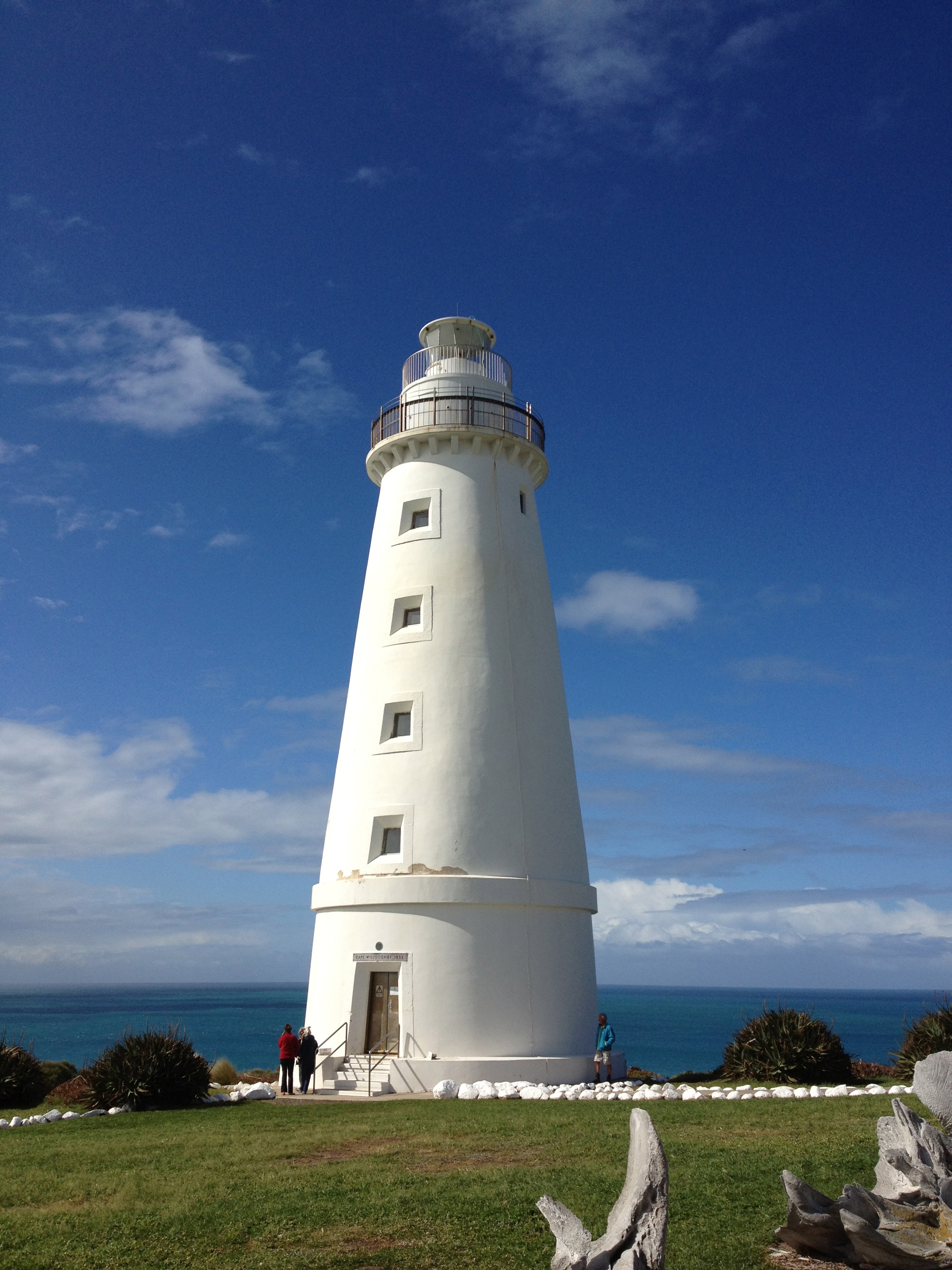
Cape Willoughby Lighthouse
It’s a coal-black night on the north coast of Kangaroo Island. Gale-force winds whack our cyclone-proof house and it sounds like there’s a percussion ensemble on the roof. Lightning flares across the sky, and below us, Kangaroo Beach is a roaring squall. It’s wild. It’s thrilling in a dark, elemental way.
But it wouldn’t have been so for those onboard the William on a night just like this in August 1847. For the 20-ton wooden cargo vessel loaded with flour, sugar and wool from Port Adelaide, it was the night the elements won. William struck a reef off the north-east coast of the Island and was the first-recorded of more than sixty shipwrecks off Kangaroo Island’s ruggedly beautiful – but unforgiving – coastline.
In 1847 there were no lighthouses on Kangaroo Island. It wasn’t until 1852 – fifty years after Matthew Flinders had explored the north of the Island and named it after the wildlife his crew gratefully consumed – that Cape Willoughby lighthouse threw a life-saving beam out from the eastern end of the Island.
In 1852, Charles Sturt – Colonial Secretary at the time – notified mariners that the Sturt Lighthouse (as it was originally known) could be see for twenty-four nautical miles, “illuminating 259 degrees of a circle”. Flashing across the Backstairs Passage – the narrow strait between Cape Jervis on the Australian mainland and the eastern end of the Island – it was an important landmark for the rapidly expanding shipping trade into and out of the new ports at Adelaide and Melbourne.
It’s still an impressive landmark with three neat, red-roofed cottages at its base. Emerging from the dense scrub which borders the unsealed road to Cape Willoughby, it’s as welcoming a sight as it must have been from the water, and appears like a tiny colonial village on the edge of the Cape Willoughby cliffs.
When first built, the lighthouse lantern was banks of oil-burning lamps and parabolic mirrors emitting a white flash as they revolved. The first light-keepers climbed the 102 stairs to the lantern room to ‘trim the lamps’ every two-hours to maintain a one-inch flame and keep a bright light burning. Today it runs on electricity, and like all lighthouses in Australia, is monitored electronically and doesn’t require a resident light-keeper.
William Cawthorne, son of the first light-keeper at Cape Willoughby, kept a diary of his 1853 visit to his father. He noted that “upwards of 120 [snakes] were killed in the first year of [the lighthouse] operation. They were everywhere! These with the hawks, guanas, [goannas] and blowflies are the pests of the place”. He found his father living “midst a solitude profound” and “saw the gigantic rollers that set in, which when they break, cause the very earth to vibrate”.
That solitude determined how they lived: “as the poor keepers have no regular communication with town, they are frequently very hard up for want of provisions. Salt meat, of course, is the staple article, varied with goat and pork. When I arrived, they were smoking hops for tobacco, and using roasted peas for coffee”.
Cameron Macphee, Ranger at the Cape Willoughby lighthouse, is clearly inspired by his environment. He lights up when asked about light-stations, and what might have motivated the early light-keepers to endure the isolation. “Most of the early keepers were ex-sailors,” he says, “so having a good wage, food, and living, must have been a more acceptable existence than life at sea”.
Wren Lashmar, a fifth-generation Kangaroo Islander, concurs: “most just loved the sea, ships and isolation”. Growing up on the Island, he loved to look at the “wonderful rotating beam” each night and describes his work as tour guide and site manager at Willoughby from 1992 until 2007 as “more than just a [light] keeper, more a jack-of-all-trades”. Maintaining the light and buildings, being the “eyes” of customs and fisheries authorities, and three- or six-hourly weather reports were all part of the job. He estimates that he’d climbed one-and-a-half million stairs by the time he retired. His weather reports were technical assessments of cloud cover, type and direction; wave and swell height, and direction; temperature; rainfall; wind speed and pressure; and visibility, “but when used to reading weather one look at the sky and sea tells you what’s what. Even at night”.
Like the Cape Willoughby light, weather reports are automated now. There’s no need for people like Wren with his lifetime of local experience and knowledge. It feels like a loss to me. It feels like a loss of humanity to technology. It feels like that to him too: “I miss it to this day”.
Further reading and some useful websites…
Chapman, Gifford. Kangaroo Island Shipwrecks. Canberra: Roebuck, 1972
Ibbotson, John. Lighthouses of Australia. Australia: Australian Lighthouse Traders, 2001
Loney, Jack. An Atlas History of Australian Shipwrecks. Sydney: A.H. & A.W Reed Pty Ltd, 1981
Reid, Gordon. From Dusk to Dawn. Australia: The Macmillan Company of Australia Pty Ltd, 1988
Websites
Australia for Everyone website
http://www.australiaforeveryone.com.au/places_kangarooisld.htm
http://www.environment.sa.gov.au/parks/Find_a_Park/Browse_by_region/Kangaroo_Island/Cape_Willoughby
Lighthouses of Australia websites
http://www.lighthouse.net.au/Lights/SA/Cape%20Willoughby/Cape%20Willoughby.htm
http://www.lighthouse.net.au/lights/Bulletin/0304/Bulletin%20Apr%2003.htm
 australian lighthouses