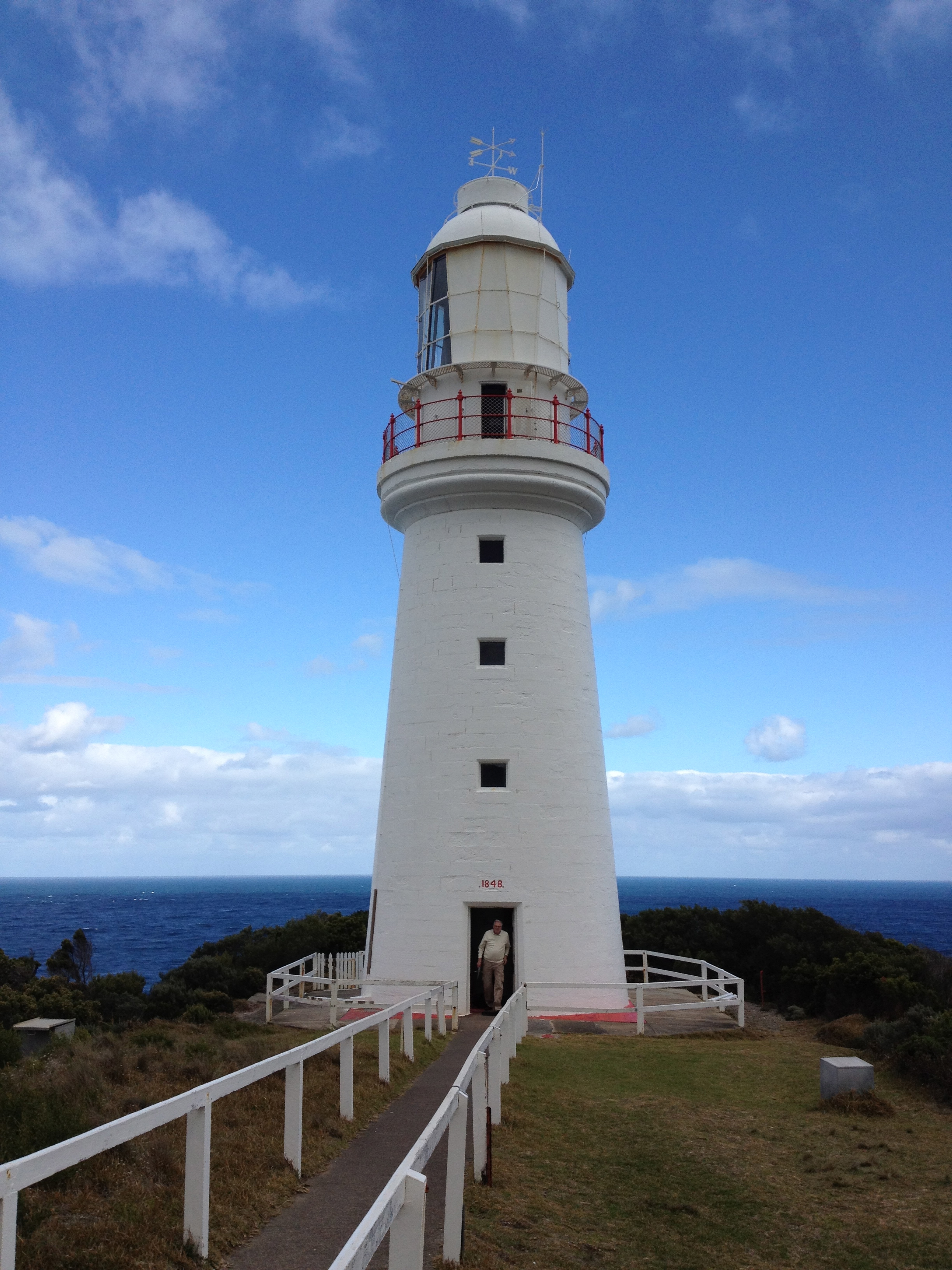
 Ninety metres below the Cape Otway lighthouse, breakers sweep over the Cape Otway reef and crash onto the granite cliffs lining the shore. Staring out beyond the breakers, I think of the people who might have looked back from out there, back towards this lighthouse site. The people who sailed past this Cape before each stone block was cut by hand and laid in decreasing concentric circles in 1848.
Lieutenant James Grant did. He was on board the Lady Nelson sailing eastwards past Cape Otway in 1800. The Lady Nelson’s sliding keel took some of the risk out of early coastal surveys when explorers didn’t yet know if there was a continuous coastline from west to east. Grant had safely navigated the ‘eye of the needle’, the 84-kilometre-wide passage between Cape Wickham on the northern tip of King Island, and Cape Otway on the mainland.
Nicolas Baudin, French explorer on board Le Geographe, and Matthew Flinders, commanding the British Investigator, were both on voyages of discovery when they looked back towards this Cape in 1802. Baudin and Flinders both noted the breakers. They had to. Breakers indicate rocks, reefs, and in sailing vessels at the mercy of winds which may, or may not, favour a swift change of course, not seeing or hearing breakers is a voyage-changer.
The charts Grant and Flinders helped complete during their early nineteenth century voyages took some of the uncertainty out of travelling to the new colony. Even with more complete charts though, the weather, the geography, and the absence of any lighthouses elevated above the coastline to mark islands and the breakers belonging to them, led to disastrous wrecks.
Reefs like the one beneath me and further along the coastline – now called Victoria’s ‘Shipwreck Coast’ where many of Victoria’s 638 shipwrecks lie – were sometimes seen or heard too late for ships under acres of sail to change direction. Cape Otway marks the entry into Bass Strait and is renowned for its sea mists, its gales wild enough to drown out the thump and crash of the surf, and howling, variable winds.
When the Cataraqui struck a reef off King Island in 1845 and 399 people perished, political and social pressure began to mount for lighthouses on Cape Wickham (King Island) and Cape Otway to mark that ‘eye of the needle’. In 1846, British Admiralty Captain W.A.B Hamilton wrote to the Secretary of State for Colonies, William Gladstone, and noted that ‘…a single light on that island, or on Cape Otway, would have prevented this frightful misfortune.’ (Cited in Walker, D. Beacons of Hope. Victoria: Neptune Press, 1981)
Work began in December 1846, but it wasn’t until August 1848, after 40 stonemasons and 30 other workmen had worked on the structure, that the Cape Otway Lighthouse beam shone across Bass Strait for the first time. The stone was cut from Parker River, five kilometres away, and carted to the lighthouse site with a bullock dray.
Cape Otway is the oldest lighthouse in Victoria, and was only the third built on the Australian mainland. It stands 91 metres above sea level, and twenty-one oil lamps with reflectors arranged in groups of seven gave a single three-second flash every fifty-three seconds to the ships heading for eastern Australia. In 1891 the original apparatus was replaced by a Chance Brothers first-order lens comprising fifteen glass panels arranged in five groups of three. The Cape Otway lighthouse then triple-flashed every minute.
The original Cape Otway lighthouse has been replaced by a two-metre light tower in front of the original building. The original lighthouse is well maintained though, and it is worth visiting to see that magnificent, intact Chance Bros lens.
Further reading and some useful websites:
Charlwood, Don. Settlers Under Sail. Australia: Burgewood Books, 1978
Flinders, Matthew. Journal on HMS ‘Investigator’, vol. 1, 1801-1802, State Library of New South Wales archive, accessed via http://acms.sl.nsw.gov.au/item/itemdetailpaged.aspx?itemid=412367
Ibbotson, John. Lighthouses of Australia. Australia: Australian Lighthouse Traders, 2001
Loney, Jack. An Atlas History of Australian Shipwrecks. Sydney: A.H. & A.W Reed Pty Ltd, 1981
Loney, Jack. Shipwrecks along the Great Ocean Road. Australia: Marine History Publications, 2003
McHugh, Evan. Shipwrecks – Australia’s Greatest Maritime Disasters. Australia: Penguin (Viking Imprint), 2003
Reid, Gordon. From Dusk to Dawn. Australia: The Macmillan Company of Australia Pty Ltd, 1988
Walker, Donald. Beacons of Hope, an early history of Cape Otway and King Island Lighthouses. Victoria: Neptune Press, 1981
http://australia.gov.au/about-australia/australian-story/early-austn-shipwrecks
http://www.flagstaffhill.com/media/uploads/ShipwreckTrail.pdf
http://www.lighthouse.net.au/lights/vic/cape%20otway/Cape%20Otway.htm
 australian lighthouses