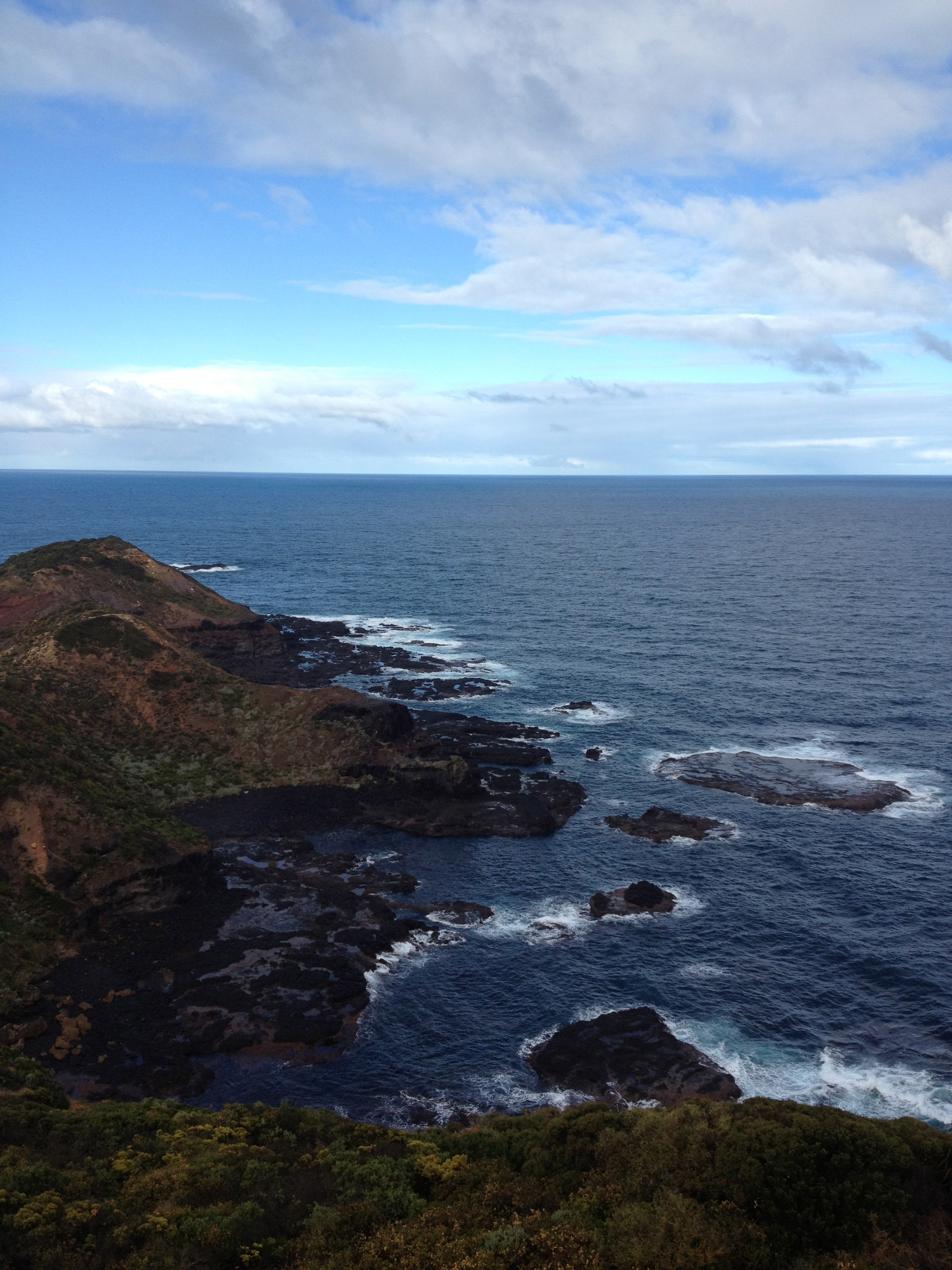
 Constructing the Cape Schanck lighthouse began in 1857 and finished in 1859. Named by Lieutenant James Grant after the man who invented the sliding keel on Grant’s survey ship, the Lady Nelson, Cape Schanck is the most southerly point of the Mornington Peninsula, Victoria. Advice to mariners issued in the Victorian Government Gazette in May 1859 noted that the flashing white light at Cape Schanck could be seen for twenty-three nautical miles out to sea. Well, in clear weather!
The 21-metre high lighthouse is built of locally quarried limestone and has an unusual spiral stone staircase which joins its inner and outer walls. The South-American Mahogany-lined lantern room with its brass fittings and motorised (previously weight-driven) mechanism for turning the light make this a very special working lighthouse destination.
Like Cape Otway, Cape Schanck has a Chance Bros first-order lens system (installed in 1915) and today, the halogen lamp which replaced the whale oil, then kerosene burners which kept the original lamps burning, produces a short flash equivalent to 1.7 million candles and is visible for 27 nautical miles.
Three lightkeepers and their families lived at Cape Schanck, and while this lighthouse location is not as remote or isolated as other coastal lights in Australia, stores were still only delivered to the Dromana pier twice a year until 1939.
All lighthouses in Australia are now automated and the lightkeepers houses at Cape Schanck are popular as a get-away option with a difference. The site is beautifully maintained, and a small museum in one of keepers’ cottages provides a comprehensive history of the Cape Schanck lighthouse and its apparatus.
 australian lighthouses