
South Australian Lighthouses – Map courtesy of John Ibbotson
The first Australian lighthouse – the Macquarie Light – threw a beam out from South Head in Sydney in 1818. Prior to that, the only white-settler beacon on the mainland was a fire lit in an iron basket in the same location from 1794. It’s hard to imagine the Australian coastline without lighthouses. It’s hard to imagine making the three-month journey from England to Australia and skirting the hazardous coast without the aid of life-saving beams. And it’s hard to imagine what it would have been like to experience the terrifying sound of a ship colliding with a reef, often only metres from safety on a dark, foreign shore.
Many of these wrecks occurred along the southern coastline, and South Australia and Tasmania were some of the first coastlines to be lit.
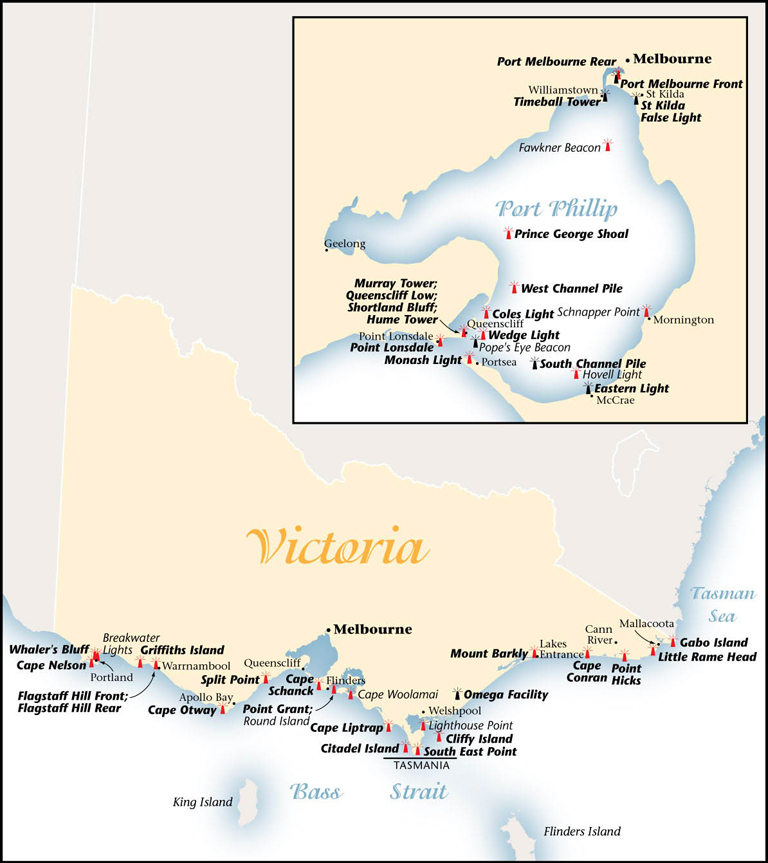
Lighthouses in Victoria – Map courtesy of John Ibbotson
Today, Australia’s capes and headlands are lit by automatic lights which shine in towers or other structures that don’t require lightkeepers keeping the lamps burning from dusk to dawn. These maps of Victoria and South Australia (courtesy of John Ibbotson, author of Lighthouses of Australia Images from the End of an Era) show just how many lights were needed to assist the safe passage of ships in- and out-of Australian ports. Even with these lights, many disastrous wrecks still occurred, often requiring the keepers of the lights to rescue or assist stranded travellers or crew.
Many of the lights on these maps are open to the public, and they all have their own history and story.
 australian lighthouses